From Assistant to Operator: How AI Tools Stopped Just Answering Questions — and Started Running Your Work

A plain-language guide to the platforms reshaping how people work, and what your choice of AI quietly says about you.
I. The Conversation That Already Moved On
Picture a scene that has probably played out on your screen at some point in the last year. You open ChatGPT, paste in a long email thread, ask it to summarize the key points, and feel — reasonably — that you are using artificial intelligence. You are doing something that would have seemed remarkable five years ago. You are also, in a quieter sense, watching a film that started before you arrived.
While that summary was generating, the same platforms that power your assistant had already shipped something categorically different. Not a smarter chatbot. Not a faster one. Something that operates on a different principle altogether: agents that browse the web on your behalf, write and execute code, manage files, fill out forms, coordinate multi-step tasks across applications, and continue working after you have closed the window and gone to bed. The conversation, in other words, had already moved on.
This is not a criticism. Most people who use AI tools daily are using a fraction of what is already available to them — not because they are incurious, but because the products evolved faster than the communication about them. The mental model that most people carry — AI as a very smart search engine, a writing assistant, a question-answerer — reflects what these tools were in 2023. What they are in 2026 is something considerably stranger and more consequential.
What follows is an attempt to draw that map honestly: where each major tool actually sits, what it can genuinely do, and — most importantly — what your choice between them reveals about assumptions you may not have realized you were making.
II. A Map of Where Things Actually Stand
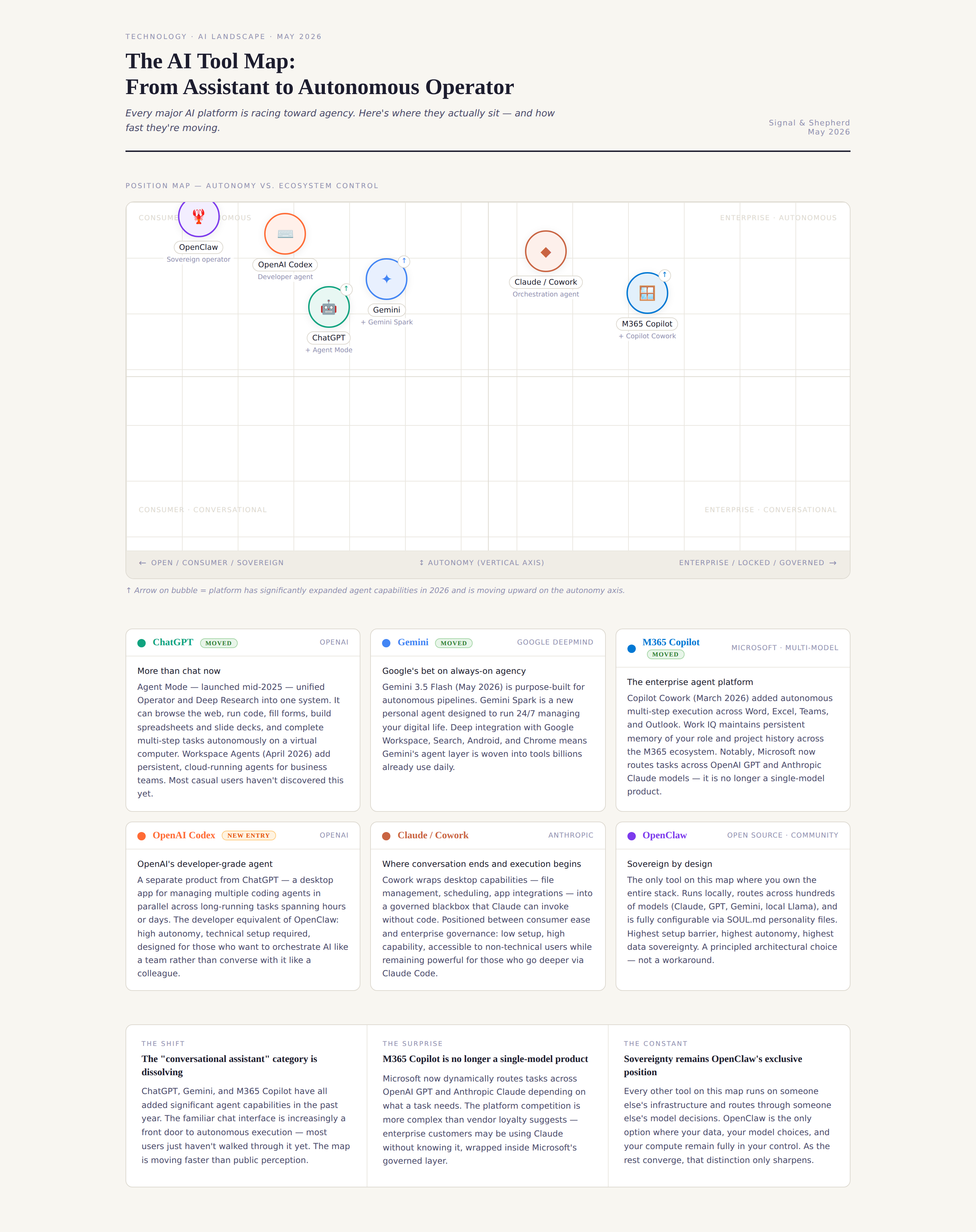
The tools available today do not form a tidy hierarchy of better and worse. They occupy genuinely different positions on two axes that matter more than raw capability: how autonomous the tool can act on your behalf, and how open or governed the environment it operates in. Understanding those two dimensions makes the differences between the tools legible in a way that feature comparisons never quite do.
TIER ONE
The Conversational Front Door (ChatGPT · Gemini)
These are where most people's experience of AI begins and, for many, remains. The interaction is fundamentally dialogic: you write, it responds. The quality of that response has become extraordinary — sophisticated enough to draft legal summaries, tutor in mathematics, generate working code, and hold a coherent line of reasoning across a long conversation. For the majority of everyday knowledge tasks, this tier is more than sufficient.
What most users do not realize is that both platforms have been quietly expanding well beyond the chat window. ChatGPT's Agent Mode — available to paid subscribers since mid-2025 — can operate a virtual computer on your behalf: browsing websites, running code, building spreadsheets, completing forms, and returning finished deliverables rather than just responses. Gemini, similarly, is building toward always-on personal agency through Gemini Spark, designed to manage your digital life continuously rather than responding only when addressed. The familiar chat interface has become, for both platforms, a front door to something much larger.
TIER TWO · ENTERPRISE VARIANT
AI Embedded in the Organization (Microsoft 365 Copilot)
Microsoft 365 Copilot occupies a distinct position not because it is more powerful, but because it is woven into the fabric of how organizations already work. It lives inside Word, Excel, Teams, Outlook — not asking you to switch to a new application, but augmenting the ones your organization has spent years building workflows around. In March 2026, Microsoft launched Copilot Cowork, an agentic execution layer that can autonomously run multi-step tasks across M365 applications, coordinate between them, and continue working while you are in other meetings. Work IQ, a persistent memory layer introduced alongside it, maintains awareness of your role, your projects, and your organizational context across every Microsoft application.
TIER THREE
Where Conversation Becomes Execution (Claude / Cowork · OpenAI Codex)
This is where the category changes in a more fundamental way. Claude, developed by Anthropic, has always been distinguished by its reasoning depth and its careful approach to following complex instructions across long tasks. Cowork extends that into a governed execution layer: capabilities like file management, scheduling, and application integrations are pre-wrapped into a blackbox that Claude can invoke without the user writing a single line of code. The gap between having an idea and acting on it narrows to almost nothing.
OpenAI Codex occupies a parallel position but aimed squarely at developers: a desktop application that manages multiple coding agents running simultaneously across long-running projects that can span hours or days. Both tools represent the threshold where AI stops responding to you and starts operating for you.
TIER FOUR
The Sovereign Operator (OpenClaw)
OpenClaw is the outlier on this map, and deliberately so. An open-source agent harness that runs entirely on your own machine, it allows you to route tasks across hundreds of AI models — Claude, GPT, Gemini, or locally-running models that never connect to any external server — and configure agent behavior at a granular level. It requires genuine technical comfort to set up and maintain. In exchange, it offers something no other tool on this list can provide: complete ownership of your data, your compute, and your model choices. For those who understand the tradeoffs, this is not a workaround. It is a principled architectural choice.
The familiar chat interface has become, for most platforms, a front door to something much larger. Most users just haven't walked through it yet.
III. The Surprise Inside the Enterprise
Of everything the research for this article surfaced, one finding is the most counterintuitive, and worth dwelling on: Microsoft 365 Copilot is no longer a single-model product.
Microsoft, for much of its AI journey, has been closely associated with OpenAI — the company it invested in heavily and whose GPT models powered the early versions of Copilot. That association remains partly accurate. But in 2026, Microsoft's Copilot platform dynamically routes tasks across both OpenAI's GPT models and Anthropic's Claude, selecting the model it judges best suited to each task. Enterprise users working inside Microsoft's tightly governed environment may already be interacting with Claude — not through any decision they made, but through Microsoft's routing logic operating silently beneath the surface.
This matters for a few reasons. It means the competition between AI companies is more complex and more fluid than vendor loyalty suggests. It means the boundaries between platforms are more porous than they appear. And it means that the question of which AI you are using is, for enterprise users, increasingly answered not by them but by their platform provider — on their behalf, according to criteria they may not have examined.
Worth Knowing
Microsoft routes between models. M365 Copilot's multi-model architecture dynamically selects between OpenAI GPT and Anthropic Claude depending on what each task requires. Enterprise users are not choosing between these models — the platform chooses for them.
The "Cowork" name appears twice. Both Anthropic and Microsoft launched products called Cowork in 2026 — Anthropic's for desktop automation, Microsoft's for M365 workflow execution. They solve similar problems for different primary audiences.
Codex is not ChatGPT. OpenAI Codex is a separate product — a desktop application for managing multiple autonomous coding agents in parallel — not a feature of the ChatGPT interface. It targets developers and technical teams, not general users.
IV. The Choice Beneath the Choice
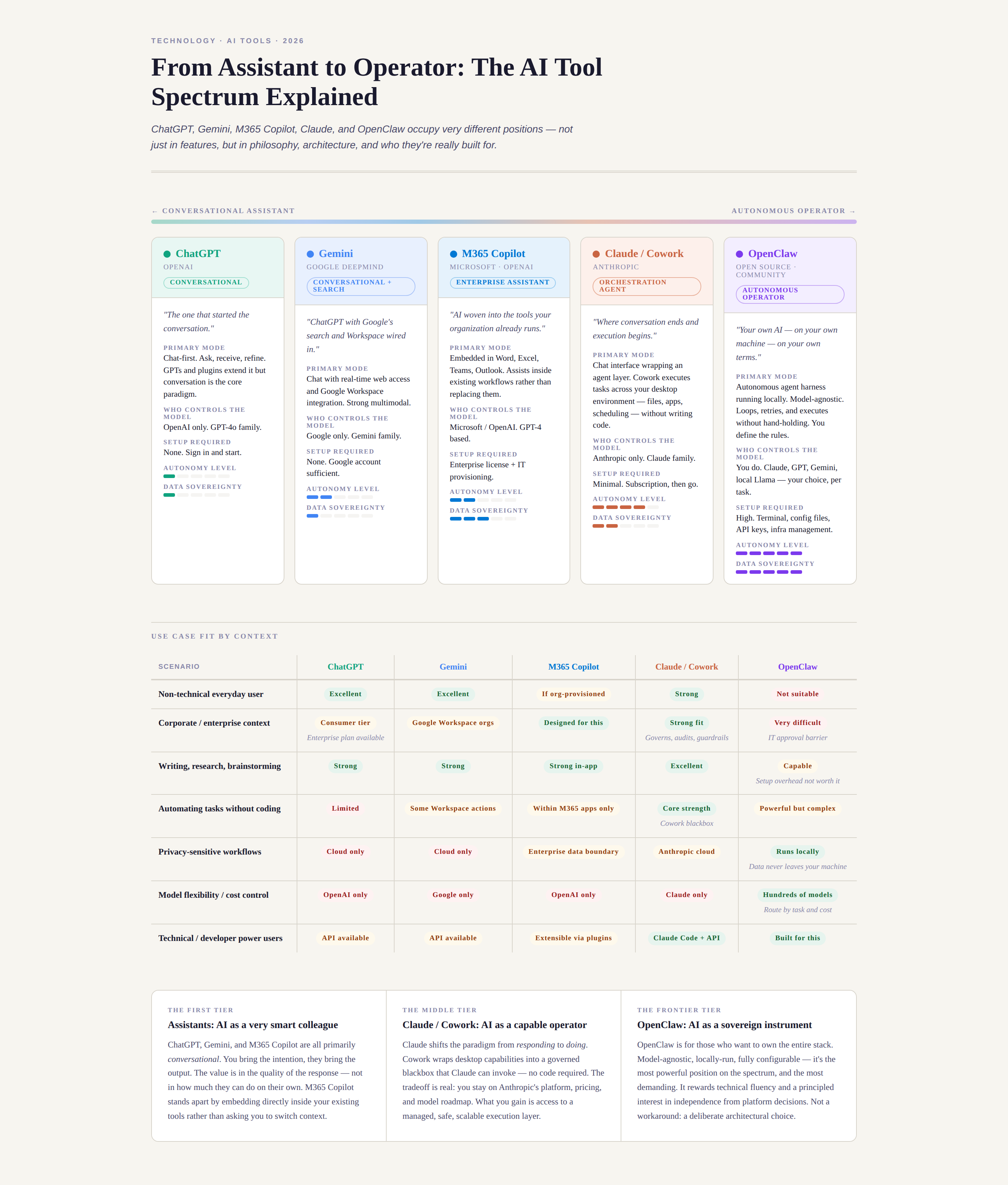
Here is what the feature comparisons and capability reviews tend to omit: choosing an AI tool is not primarily a decision about features. It is a decision about three things that rarely appear in product announcements — and that most people are deciding without realizing it.
The first is who owns your infrastructure. Every tool on this map except OpenClaw runs on someone else's servers, processes your data through someone else's systems, and operates according to terms of service that someone else wrote and can revise. This is not inherently problematic — it is the nature of every cloud service you have ever used — but it is worth making conscious. When Anthropic adjusted how third-party tools could use Claude subscriptions in early 2026, users of OpenClaw found their workflows disrupted by a decision made without their input. The platform giveth, and the platform can revisit the arrangement.
The second is who controls your model. With the exception of OpenClaw, every tool on this list routes you through a single provider's model — or, in Microsoft's case, routes you between models without your knowledge. You have no input into which model version you are using, when it changes, or what tradeoffs the provider made in its training.
The third is how much platform dependency you are willing to accept. Every platform lock-in begins as a convenience. The value of integration — of having your AI know your calendar, your files, your email, your organization's structure — is real and significant. So is the cost of leaving. The more deeply a tool is woven into how you work, the more expensive it becomes, in time and disruption, to move to something else.
Most people are deciding these questions — about infrastructure, model control, and platform dependency — without realizing the questions are being asked.
None of this is an argument for any particular tool. The person who uses ChatGPT for conversational assistance is making a perfectly reasonable choice. The enterprise team running M365 Copilot is making an equally reasonable choice for their context — prioritizing governance, auditability, and integration with existing systems over model transparency or pricing flexibility. The technically fluent individual running OpenClaw on their own machine is making a choice that is principled and considered, if demanding. What matters is not which choice you make, but whether you are making it — rather than simply accepting the default nearest to hand.
V. The Practical Read
Rather than recommending a specific tool — which would be both presumptuous and likely out of date before this article reaches you — what follows is a set of three questions worth sitting with. The answers point toward a tier, not a product. That is intentional: the specific products will keep changing. The questions are more durable.
QUESTION 1: What are you actually trying to do?
If your primary need is thinking, writing, research, and conversation — the first tier serves you well and with very low friction. If you want to automate tasks, execute workflows, and have AI act on your environment rather than just respond to your questions — you need to be looking at the second and third tiers. Most people have not asked themselves this question clearly enough to know which applies.
QUESTION 2: Who do you trust with your data — and under what terms?
This is less about paranoia and more about proportionality. Conversations about personal matters, sensitive professional information, or proprietary organizational data carry different considerations than asking for a recipe or a travel itinerary. Understanding where your data goes, how long it is retained, and what it might be used for is a basic due diligence question, of the same kind you would apply to any service provider.
QUESTION 3: How much do you want to own?
Ownership comes with responsibility. The sovereign position — running your own infrastructure, managing your own models, maintaining your own configuration — offers genuine independence and is a legitimate choice for those equipped and inclined to make it. For most people, the tradeoff favors managed platforms. But "most people" is not a category that determines what is right for any specific person. The question is worth asking with your eyes open.
One final observation, offered not as prediction but as orientation. The category distinctions drawn in this article — between conversational assistants and autonomous operators, between consumer openness and enterprise governance — will blur further within the next twelve months. The platforms in the conversational tier are actively building toward the operator tier. The enterprise platforms are acquiring agent capabilities at speed. The map is not static.
What is worth holding onto, then, is not the current position of any particular tool, but the habit of paying attention to the direction of travel. The terrain is moving. The people who navigate it well are not necessarily those who chose the right tool at the right moment. They are the ones who understood what the tools were actually doing — and made deliberate choices about how far they wanted to follow.

